
By: Kaila Weingarten MS ED
Play is crucial to a child’s development. It helps build your child’s imagination, encourages socialization and communication, and enhances many other areas of your child’s development. Early childhood experiences have a dramatic impact, physically determining how the intricate neural networks of the brain are wired. In a report, titled The Importance of Play in Promoting A Healthy Child, the American Academy of Pediatricians wrote: "These guidelines are written in response to the multiple forces challenging play. The overriding premise is that play (or some available free time in the case of older children and adolescents) is essential to the cognitive, physical, social, and emotional well-being of children and youth. Our society often confuses learning with memorization and test scores with success. The challenge is to strike a balance… between the desire to enrich children’s lives and the need to foster play as a foundation for learning skills like collaboration, communication, content, critical thinking, and creative innovation and confidence.
What is play? Psychologists have agreed on five essential characteristics that are typical of play (Rubin, Fein and Vandenberg, 1983). First of all, play is intrinsically motivated. It is done for the utter satisfaction of doing it, and is an end to itself. A second feature is that it must be freely chosen by the participants. If children are forced, or even gently pressured, into play they may not regard the assigned activity as play at all. A third essential characteristic is that it must be pleasurable. An experience that a child does not enjoy cannot be considered play. The fourth point of play is that it is nonliteral. There is an element of make believe, a distortion of reality that interests the player. Finally, play is actively engaged in by the player. The child must be involved physically, psychologically, or both, rather than indifferent to what is going on. Play occurs throughout life, throughout different changing forms.
Children move through various phases of play as they develop. Following are some simple stages of social play. Between ages 0-2 years, children usually play alone, and there is little or no interaction between children. At age 2-2 1/2 they start to parallel play – they play alongside others, but not together. By about age 3 children engage in cooperative play – they are happy to play together and share goals in play. As an educator, I strive to engage children in a variety of play experiences, including the four main areas of play: imaginative play, construction, creative play, and physical play. You learn about your child by observing and listening to her play. As an adult, you can facilitate development by co-playing with child, asking open-ended questions, and suggesting ways to explore materials that your child might not think of. What type of play helps enrich your child’s learning? 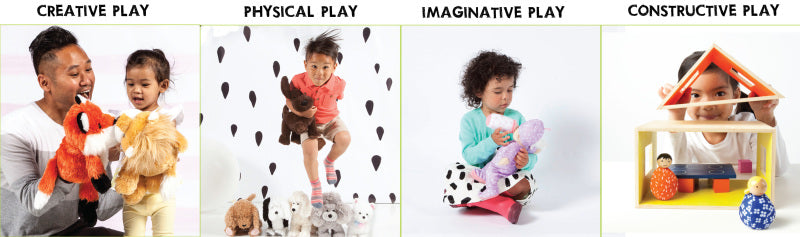
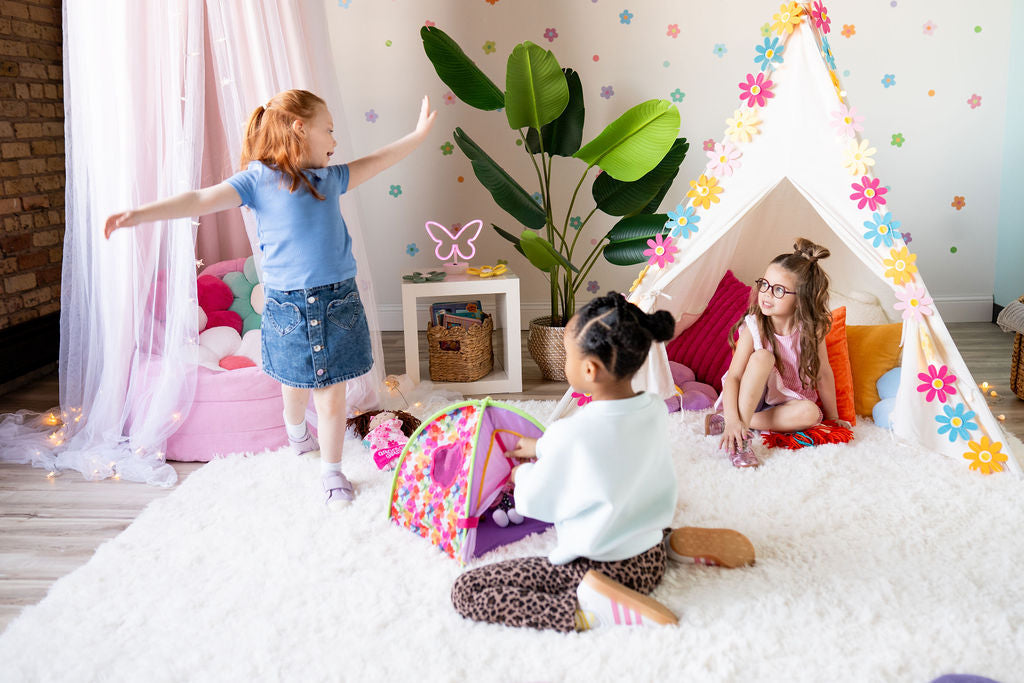
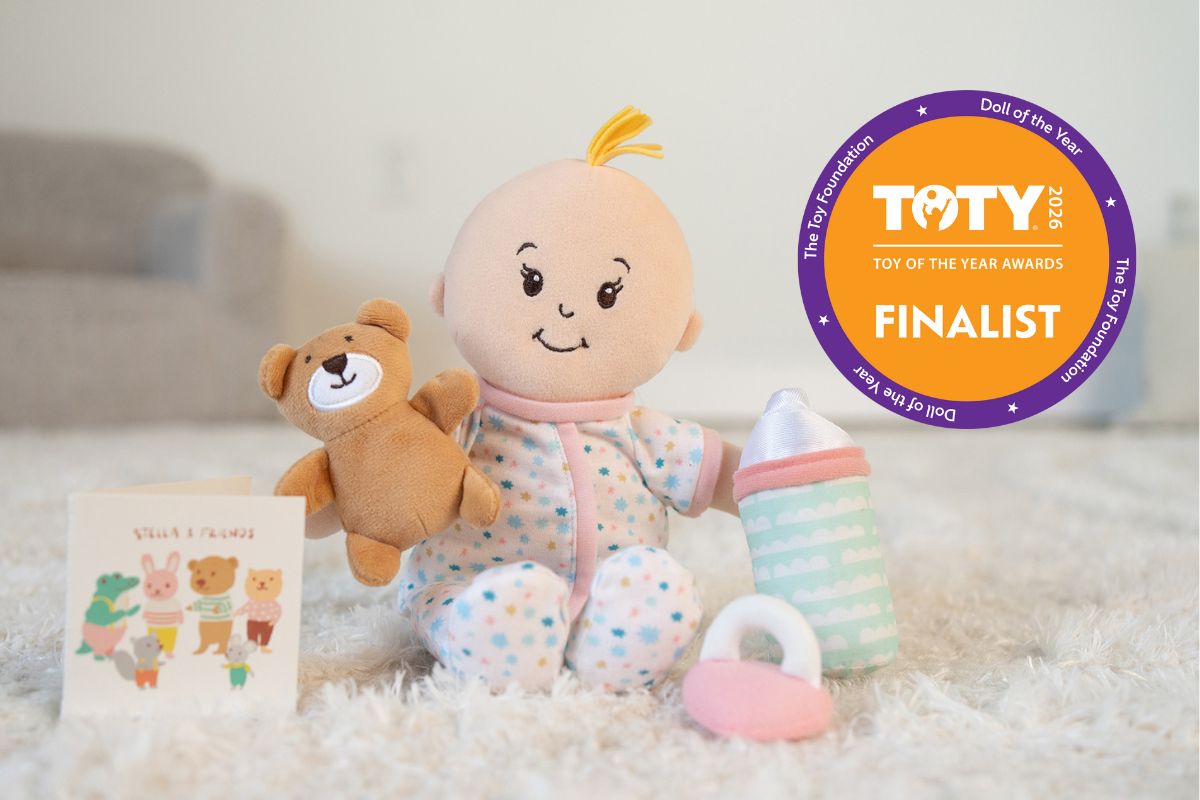
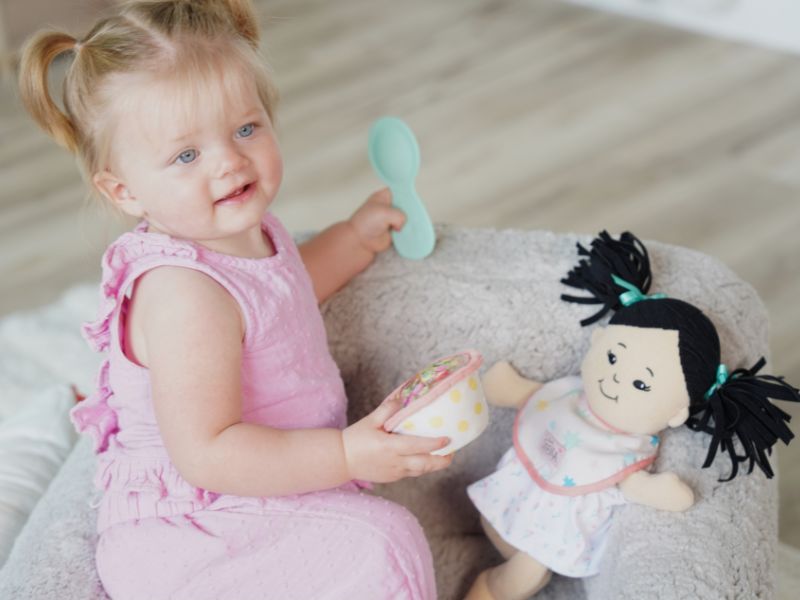
- Imaginative play includes pretend, fantasy and symbolic play. It typically begins to develop in 1-2 year olds, and continues to grow in complexity. It is a terrific time for children to explore their experiences in a non threatening manner, and promotes self expression and social skills. My girlies love their dolls and accessories and role play various family members taking care of children. Another thing they enjoy is puppets, which help play out stories and scenes from the imagination.
- Construction is the process of building an end product from a range of material. The most important part is the process, not the end product. Children begin with constructive play at about age 2. It is a great opportunity to develop fine motor skills and language by talking about what they are building. Encourage construction with big blocks and manipulatives.
- You can see your child’s creative play in the art as well as other forms of creative self expression during music and movement.
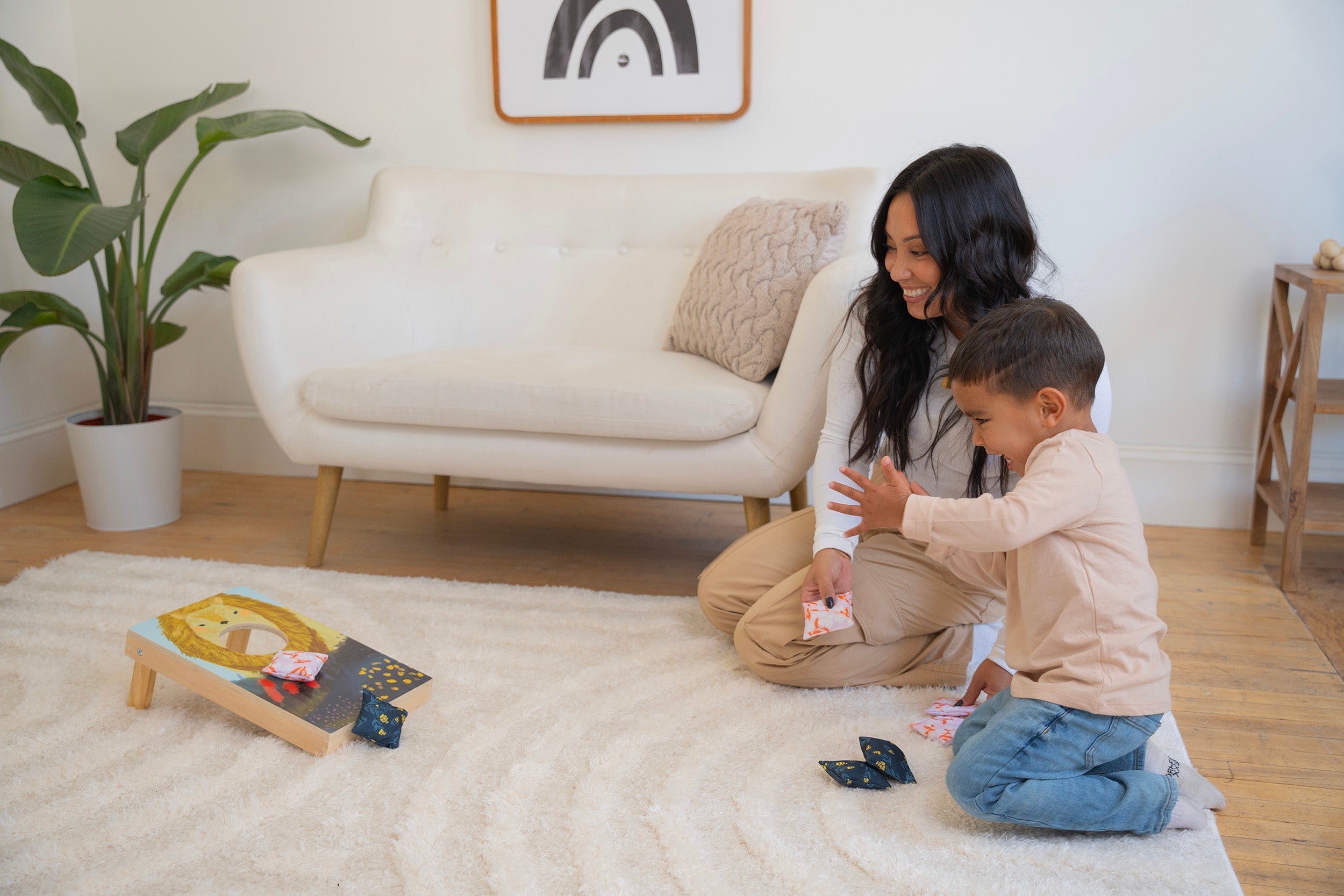
- Physical play is something to encourage at every age and stage. During the day, your child can enjoy many indoor and outdoor physical activities which either involves some of the excellent equipment or no equipment at all. Some of a child’s fondest memories may be built around physical play, building fine and gross motor skills, as well as muscle control. So get that ball rolling!


Move to Music
10 No-Nonsense Spring Cleaning Tips